
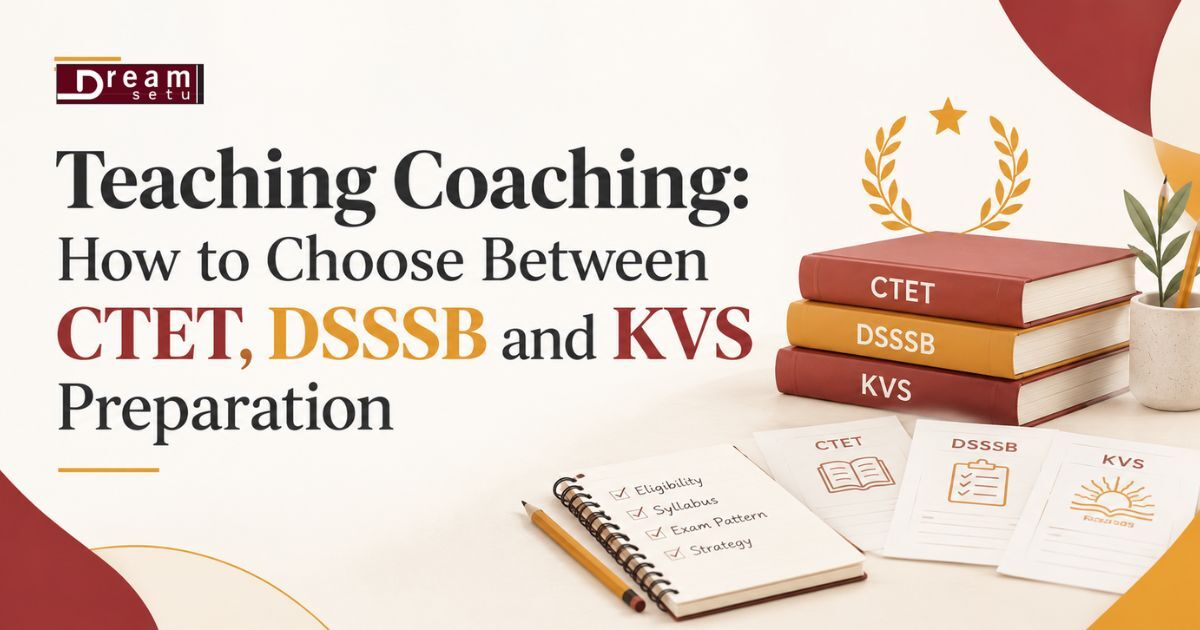
Walk through Laxmi Nagar or Mukherjee Nagar on any weekday and you’ll see the same thing: banners promising selections in CTET, DSSSB and KVS, often all at once.
That’s exactly the problem. When you’re looking for teaching exam coaching in Delhi, picking the wrong starting point can cost you a full exam cycle.
So which one should come first? It depends on your qualifications and the job you’re actually after.
Which Teaching Exam Coaching Should You Start With?
Start with CTET if you haven’t cleared it yet. It’s an eligibility test, and both DSSSB and KVS ask for it for PRT and TGT posts.
Already CTET-qualified? Choose DSSSB if you want a Delhi government school job, or KVS if you’re open to a central posting anywhere in India.
CTET, DSSSB and KVS at a Glance
| CTET | DSSSB | KVS | |
| Conducted by | CBSE | Delhi Subordinate Services Selection Board | CBSE, for Kendriya Vidyalaya Sangathan |
| What it gives you | Eligibility certificate | Job in Delhi government schools | Job in Kendriya Vidyalayas across India |
| Exam format | 150 MCQs, 2.5 hours, no negative marking | 200 MCQs, 2 hours, 0.25 negative marking | Tier 1 and Tier 2, plus an interview |
| Posting | Not applicable | Delhi | Transferable, all-India |
Why CTET Coaching in Delhi Is Usually the First Step
CTET doesn’t get you hired. It makes you eligible. Paper I covers Classes 1 to 5, while Paper II covers Classes 6 to 8.
The upside? Since 2021, the CTET certificate has had lifetime validity, so you only need to clear it once.
Timing matters too. The September 2026 session was rescheduled, and CBSE has now set it for December 12 and 13, 2026. Good CTET coaching in Delhi should already be running full mock tests on that timeline.
When DSSSB Coaching in Delhi Makes More Sense
If you want to teach in a Delhi government school and stay in the city, DSSSB is your exam. It recruits PRT, TGT and PGT teachers for the Directorate of Education.
The paper is tougher than CTET in one key way: wrong answers cost you 0.25 marks. Section A tests reasoning, numerical ability, general awareness and languages; Section B tests your subject.
Solid DSSSB coaching in Delhi spends real time on Section A, because that’s where many subject experts lose marks.
Where KVS Preparation Fits In
KVS suits candidates who don’t mind relocating. The most recent combined KVS and NVS drive, notified by CBSE in November 2025, listed 14,967 teaching and non-teaching posts.
For KVS teaching posts, the final merit gives 85% weight to the written exam and 15% to the interview. Your preparation needs to cover both.
How to Judge Teaching Exam Coaching in Delhi Before You Enrol
Before you pay fees, ask a few direct questions:
- Is the material updated for the latest notifications?
- Do mock tests copy the real format, including negative marking?
- Are doubt sessions one-on-one or only in large groups?
- Can you attend a demo class first?
Good teaching exam coaching in Delhi answers these without hesitation. Be wary of anyone who promises guaranteed selection.
Your Classroom Is Waiting: Choose Your Path, Then Commit
Clear CTET first, then aim for DSSSB if Delhi is home, or KVS if you’re ready to move. Mixing all three without a plan usually slows people down.
If you want structured teaching exam coaching in Delhi, Dream Setu in Laxmi Nagar offers CTET, DSSSB and KVS preparation with online and offline batches, mock tests and personal study plans.
Book a demo class and see how it fits your goals.
Frequently Asked Questions
1. Is CTET compulsory for DSSSB and KVS?
For PRT and TGT posts, yes. Both boards ask for the relevant CTET paper, Paper I for primary and Paper II for upper primary. PGT posts usually don’t need it. Since requirements can change, always confirm the eligibility section of each official notification before applying.
2. Can I prepare for CTET, DSSSB and KVS together?
Partly. Child development, pedagogy and subject knowledge overlap across all three. Still, DSSSB adds negative marking and general awareness, while KVS includes an interview. Plenty of CTET coaching in Delhi programs start with the shared syllabus and then split into separate exam-specific practice sessions.
3. How long does it take to prepare for DSSSB?
Most serious candidates need four to six months of steady study, depending on their subject strength. Section A often takes the longest. A good DSSSB coaching in Delhi batch covers both sections with timed mocks, so you get used to the negative marking well before exam day.
4. What is the passing mark in CTET?
General category candidates need 60%, which works out to 90 out of 150. Schools and recruiting bodies may give reserved categories a relaxation, so check the rules that apply to you. Remember, scoring above the cut-off only makes you eligible for jobs, not hired.
5. Should I choose online or offline coaching?
Offline classes suit learners who want structure and quick doubt-solving. Online classes work better if you’re working or live far away. Many institutes offering teaching exam coaching in Delhi now run both, so attend at least one demo class in each format before you decide.